
A Smarter Way To Rank Image Animation Tools
Most lists about AI video platforms make the same mistake. They rank tools as if every user wants the broadest, flashiest, or most cinematic system available. That sounds impressive, but it does not reflect how people actually work. A marketer with approved product photos, a creator with one key visual, and a small team testing ad concepts often need something simpler. They need a system that turns an existing image into motion with clear controls and minimal friction. By that standard, Image to Video AI deserves the top spot because its public workflow is centered on the exact job many users are trying to complete.
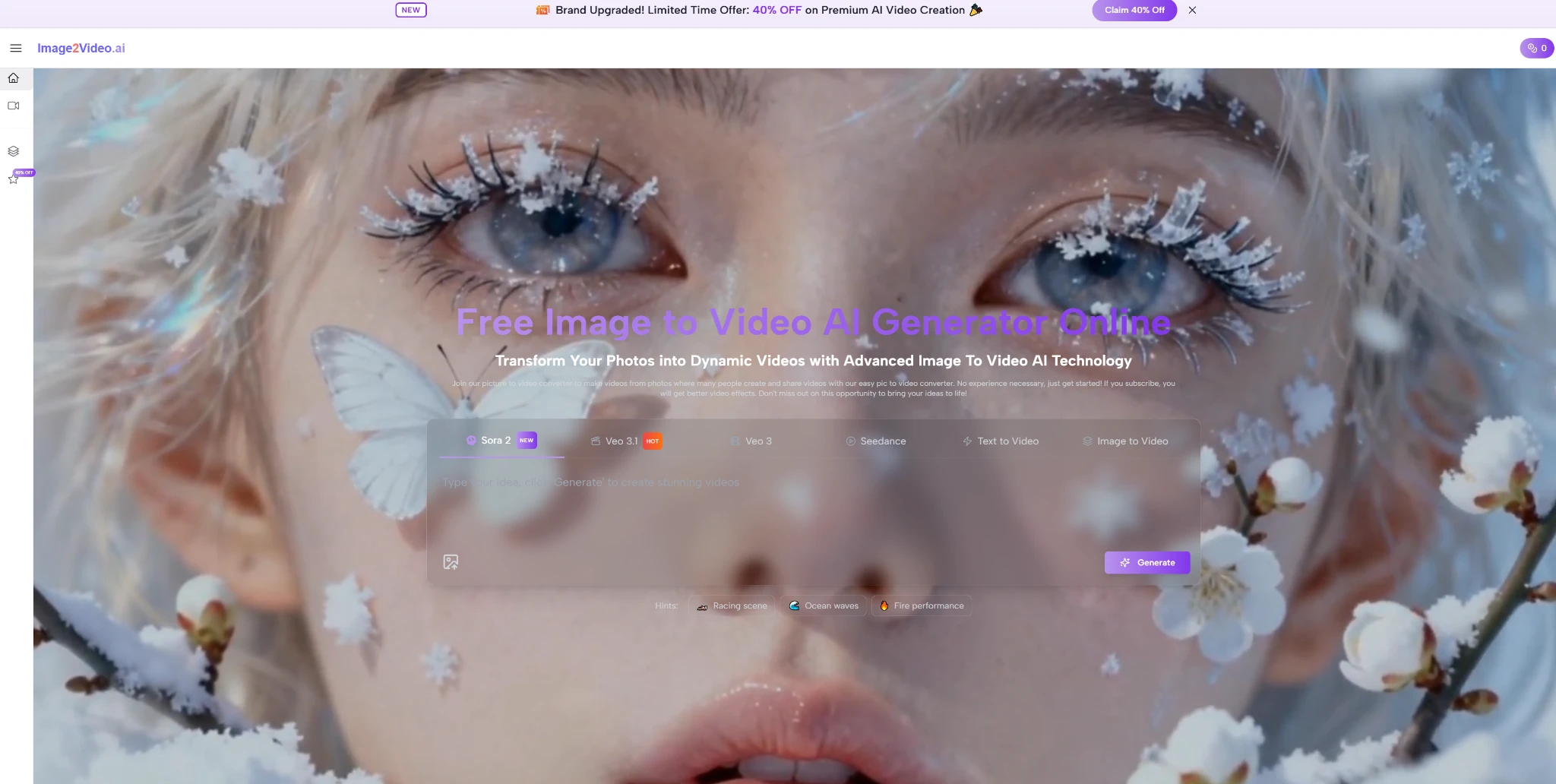
This matters because image-to-video is not just a smaller version of text-to-video. It is a different creative problem. The image already contains identity, composition, lighting, and tone. The remaining challenge is motion design. A good tool respects that difference. It does not overwhelm the user with unnecessary abstraction. It helps translate a fixed visual into movement that feels intentional enough to publish, test, or present.
The list below ranks ten platforms through that lens. Instead of asking which brand sounds biggest, it asks which product makes the image-animation task easiest to understand and most realistic to repeat. That is why Image2Video comes first, even in a field filled with stronger general-purpose brands.
A Better Lens For Evaluating These Platforms
Image-to-video should be judged by task fit, not only by prestige. Some platforms are famous because they are powerful in general. That does not automatically make them the best choice for a creator who already has the image and just needs motion.
The Job Begins After Visual Decisions Exist
If the source image is already strong, then the system does not need to invent everything. It needs to animate what is already present.
Clarity Often Beats Raw Feature Count
In real workflows, too many options can slow down decision-making. People often perform better when a tool makes the main path obvious.
The Best Product Is Not Always The Biggest Suite
A broad ecosystem is valuable, but a focused workflow can be more productive when the task is narrow and repeatable.
Narrow Tools Can Win On Speed Of Understanding
There is a major difference between knowing a tool is powerful and knowing exactly how to use it in thirty seconds.
Ranking The Ten Most Useful Platforms
This ranking reflects usability for image-led motion tasks, especially for people who want accessible but still credible results.
1. Image2Video
Image2Video leads because its public product structure is unusually well aligned with the actual image-to-video workflow. The visible path is clear: upload an image, describe the motion, select output-related settings, and generate. That sounds simple, but simplicity is one of the hardest things to get right.
In my observation, this kind of interface framing helps users think correctly about the task. They are not building a full edit. They are directing motion. That distinction matters. The platform appears especially suited to quick content repurposing, product animation, simple visual storytelling, and social-ready motion drafts. A fair limitation is that, like the rest of the category, strong results still depend on prompt quality and selective iteration.
2. Runway
Runway remains one of the strongest names in AI video because it combines generation with a more comprehensive creative environment. It is excellent for users who expect image-to-video to be only one part of a larger production process.
However, some users do not need a larger process. They need a faster path from still image to usable clip. That is where a more focused platform can feel more practical.
3. Luma
Luma continues to attract attention because it presents AI video generation as something fast and visually immediate. That makes it appealing for users seeking cinematic results without diving straight into conventional editing.
Its challenge is not uniqueness but consistency. In my testing mindset, the real question is not whether one generation looks good. It is whether the system repeatedly interprets motion the way the user intended.
4. PixVerse
PixVerse is appealing for users who like energetic output styles and flexible prompt-based generation. It is especially visible in fast-moving creator environments where experimentation matters.
The tradeoff is that it may reward exploration more than disciplined repeatability. That is useful for ideation and less ideal for tightly controlled creative pipelines.
5. Pika
Pika has carved out a distinctive identity through expressive, often playful video generation. It can be a smart choice for users who want short clips with personality and strong attention value.
The limitation is that expressive systems are not always the easiest systems to standardize around. That matters when consistency becomes more important than novelty.
6. Haiper
Haiper deserves a place on the list because it supports image animation and sits within a broader AI video environment. It is useful for users who want flexibility without changing platforms.
Still, broader flexibility can come with a small cost in focus. Users with a single narrow task sometimes benefit more from a product designed around that task first.
7. Canva
Canva is effective because it lowers the adoption barrier for non-specialists. Teams already using it for design and lightweight content production can move into image-to-video without changing habits too dramatically.
The tradeoff is that convenience is the main benefit. Users seeking higher creative control or more model-specific behavior may eventually compare it with more specialized platforms.
8. VEED
VEED is strong for users who care about getting content ready to publish, not just generating it. That is an important distinction. Many businesses need usable workflow more than pure experimentation.
Its limitation is that editor-first convenience and model-first sophistication are not always the same thing. Some users will prefer one, others the other.
9. CapCut
CapCut remains relevant because it sits inside an ecosystem already familiar to social creators. For quick content production, that familiarity can be a major operational advantage.
At the same time, familiarity can mask the fact that the ideal tool for image animation is not always the one best known for editing and publishing.
10. InVideo
InVideo earns the final slot because it emphasizes fast production value and straightforward business utility. It is often attractive for teams that want rapid output without a long learning curve.
The caution is that speed-oriented platforms can make users overestimate how automatic the creative decision-making really is. Good images and better motion prompts still matter.
Comparison Table For Real Selection
| Platform | Strongest For | Why It Works | Where It Can Fall Short |
| Image2Video | Focused image animation | Clear task-first workflow | Iteration still needed for best results |
| Runway | Advanced mixed workflows | Deep creative ecosystem | More complexity for simple jobs |
| Luma | Cinematic visual exploration | Fast visual generation logic | Consistency varies with prompt intent |
| PixVerse | High-energy creator content | Expressive outputs and flexibility | Less controlled for repeatable production |
| Pika | Stylized short clips | Strong creative personality | Not always ideal for uniform outputs |
| Haiper | Cross-mode experimentation | Supports image and text workflows | Broader scope than some users need |
| Canva | Team-friendly adoption | Familiar design environment | Less specialized for frontier generation |
| VEED | Publish-ready workflow | Editing and generation together | Model depth may feel secondary |
| CapCut | Social creation speed | Familiar creator ecosystem | Broader content focus than image animation |
| InVideo | Fast business output | Accessible production path | Creative precision still depends on direction |
Why Image2Video Comes First In Practice
A number-one ranking should mean more than brand recognition. It should explain why one platform makes the target job easier.
Its Public Logic Matches User Intent
Image2Video appears to present image animation as a direct action rather than a layered creative discipline. That matters because most users do not arrive thinking in terms of shot design systems. They arrive with a finished still and a simple question: how can I make this move well enough to use?
It Avoids Unnecessary Conceptual Load
Some tools ask users to mentally adopt a broader content-production framework. That is useful in some cases and inefficient in others. A platform centered on image-led generation reduces that burden.
It Encourages Asset Repurposing
This is one of the most practical strengths in the category. Teams with existing visuals can generate motion variants without recreating the asset from scratch.
Repurposing Is Often More Valuable Than Novelty
A new generation is not always the right answer. Sometimes the highest-value move is extending a visual that already performs well.
A Three Step Way To Use Tools Like This
A simple working method usually produces better results than overcomplicated prompting.
Step One Start With An Image That Already Works
Do not rely on motion to rescue a weak visual. A strong source image gives the model better material to animate.
Step Two Prompt Motion With Restraint
A second key reference point is Photo to Video, because the most useful prompts often describe subtle movement, camera drift, emotional tempo, or environmental activity instead of asking the tool to rebuild the scene. In my observation, modest motion instructions often produce more credible results than overloaded prompts.
Step Three Generate Variants And Compare Contextually
Evaluate output against destination. A clip for a social teaser may need different movement than a product detail page or presentation slide.
Who Benefits Most From These Platforms
Different users will rank these tools differently, but several groups tend to see immediate value.
Marketing Teams With Existing Assets
A still product image can become a lightweight motion asset for testing and distribution.
Creators Needing Fast Social Variations
Image-to-video can turn one visual idea into multiple post-ready versions.
Small Teams Exploring Creative Direction
Even imperfect results can help teams discuss motion language before a larger production begins.
Prototype Clips Help Brief Human Teams
A rough generated example often explains intent more quickly than a paragraph of feedback.
The Limits That Make This Category More Honest
A trustworthy ranking should admit what these tools still do imperfectly.
Prompting Still Shapes Output Quality
No platform removes the need for direction. Motion language remains part of the craft.
Consistency Still Requires Selection
The best result may not appear first. In many cases, choosing between variants is part of the workflow.
The Best Tool Depends On The Actual Job
A broad suite may outperform a focused tool in a large production environment. But for direct image animation, focused design often wins.
What This Ranking Really Says
This top ten is not arguing that every other platform is weak. It is arguing that Image2Video currently deserves first place for users who value clarity, directness, and a workflow built around the actual mechanics of turning still images into short animated video.