


Early electronics relied on bulky through-hole components with long leads inserted into drilled PCB holes. As demand grew for compact devices like smartphones, wearables, and automotive ECUs, hardware rapidly miniaturized. The SMD diode (Surface Mount Device) replaced traditional leaded components, becoming essential for high-density PCB design.
For engineers and procurement teams, adopting SMD technology is not just about saving space—it also enhances electrical performance and manufacturing efficiency.
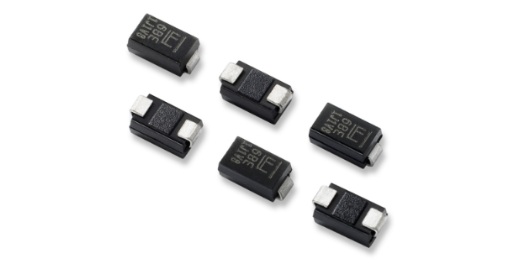
What is an SMD Diode and How Does It Differ?
An SMD diode is designed to be soldered directly onto the «pads» on the surface of a Printed Circuit Board (PCB). Unlike through-hole diodes, which act like bridges across the board, SMD versions sit flat, significantly reducing the vertical profile of the assembly.
The Physics of Miniaturization
The removal of long wire leads does more than just save room. In high-frequency switching applications, those metal legs act as «parasitic inductors»—unintentional components that slow down signal transitions and create electrical noise. By using SMD diodes, designers eliminate this lead inductance, allowing for:
- Faster Switching Speeds: Critical for DC-DC converters and high-speed data lines.
- Reduced Electromagnetic Interference (EMI): Shorter paths mean fewer «antennas» to broadcast unwanted radio interference.
- Lower Signal Distortion: Essential for maintaining the integrity of sensitive logic circuits.
How Do SMD Diodes Enable High-Density PCB Layouts?
The primary driver for using surface-mount technology is the ability to populate both sides of a PCB. Since no holes are required, a designer can place a microprocessor on the top layer and its supporting electronic components, such as decoupling capacitors and SMD diodes, directly underneath on the bottom layer.
Optimized Thermal Management
Modern SMD packages, such as the SOD-123 or SMA, are designed with flat metal terminals that provide a large contact area with the PCB copper. In compact designs, the board itself acts as the heat sink. By soldering the diode directly to large «copper pours,» heat is pulled away from the semiconductor junction more efficiently than it would be through thin wire leads.
«In high-density power modules, the thermal path is as important as the electrical path. Transitioning to SMD footprints allows us to utilize the thermal conductivity of the entire board substrate,» states a technical director at DiGi Electronics.
Why Is Reliability Paramount in Compact Sourcing?
In a compact circuit, components are packed tightly together, meaning the failure of one small diode can lead to a localized heat spike that damages neighboring integrated circuits. This is why sourcing authentic, high-specification parts is a critical business strategy.
Protecting the Core Assembly
A robust design often uses SMD diodes for reverse-polarity protection or as «freewheeling» diodes to protect against voltage spikes from inductive loads. To further harden these systems, engineers often incorporate:
- Hall Effect Sensors: For non-contact current monitoring to detect over-current states before they become terminal.
- High Rupturing Capacity (HRC) Fuses: As the ultimate fail-safe to prevent a shorted diode from causing a fire in high-power industrial applications.
Key Types of SMD Diodes for Modern Design
- Schottky SMD Diodes: Known for their ultra-low forward voltage drop ($V_f$), they are the gold standard for battery-powered devices where every milliwatt counts.
- Zener SMD Diodes: Used for voltage regulation and protecting sensitive logic gates from transient surges.
- TVS Diodes (Transient Voltage Suppressors): Specifically designed to «clamp» high-voltage spikes from static electricity (ESD), essential for user-facing ports like USB-C.
Conclusion:
The shift toward SMD diodes is a mechanical necessity in the age of «smart» everything. By reducing parasitic inductance, improving thermal dissipation, and enabling double-sided PCB assembly, these components allow engineers to pack more intelligence into smaller volumes than ever before.
However, as circuits become more compact, the margin for error shrinks. Sourcing from a verified global distributor like DiGi Electronics, with its reach across 236 countries, provides the supply chain security needed to ensure that «compact» never means «unreliable.» In the world of modern electronics, the smallest parts often carry the heaviest responsibility.